

This story was first published in Double Dealer Issue 14. Buy it here.
Chris’ mom had to go back to work because they found out she was lying. She pleaded in family court, said they didn’t understand what it was like to be Chris’ mom. She tried to tell them that he was different, and all she wanted to do was make sure he didn’t get hurt.
Over the years there were a lot of doctors that saw Chris. She’d put him in the Volvo and drive him all over the state to find the doc who could understand him. They’d all say something else. Sometimes they’d say they could put him on Adderall, sometimes they’d say he was depressed. They’d take his measurements, roll him up on the scale. Sometimes they’d say he should try to exercise.
The work she did was fine, it was normal. She did stuff with her hands five days a week, got home little after 5. Had to put her hair up in a shower cap. She left notes for Chris before she left every day. Little things. She would tell him how much she loved him, you know, she’d tell him to stay inside. She’d tell him to be careful. She’d tell him when there was ice cream in the freezer and soda in the fridge.
Chris wanted to listen to his ma. He just got so damn bored in that house, so tired of the same walls, the same rooms. Rotting smells, fried food air. It all stuck to his clothes and his skin, the drapes and furniture. The day things changed, he sat right there on the plaid woven couch. The stuffing spilled out the one arm from where the cat dug at it and he jammed his fingers in the wound and felt the foam as he watched TV.
That day he watched an infomercial about an air purifier. It was some lady in a pink shirt, she was older. Said she’d never felt better in her life before she got that air purifier. The commercial goes: “Fresh Air for a Fresh Start!” The voice over says that, it’s written at the bottom of the screen above the phone number. He thought maybe that’s what he needed, fresh air. He leaned over the arm that the cat chewed up on and looked straight out at the foyer where all the garbage was kept. Bags of it from the floor to the ceiling, bags stuffed in there like the way one of the quarter machines at the grocery is filled with gum.
Chris was piled up shirtless on that couch with his weight hanging around his body like yellow snot clings to a tissue. He wrapped one waterlogged arm around his neck and scratched at a field of pink skin tags below his left earlobe. The lady on the TV said, “It’s time to get your life back.” He broke one of the skin tags open and looked at the blood it embedded in his chewed up fingernails. The lady said, “It’s time to reach your full potential.” He put the finger in his mouth and tasted metal.
He went to the window to see his mom’s fears. Outside the sun soaked into the grass and the road and laid heavy on it all, even the little birds that fluttered in the dried mud seemed hot. If they could they’d have had their wings on their knees to catch their breath but those are not the tools they were given and so they did what they could. Across the road there was a field. It belonged to a farmer once but he was dead and now it sat there unfarmed, reclaimed. He saw out there two skinny boys with hay for hair, crouched in the overgrowth, their heads floating among the resilient grasses. He scratched at the leathery spot on his scalp and sniffed his fingers. Out there those boys stayed hunched and he watched them a while to see if they moved and he could not be sure if they were really there.
When Chris got to the edge of the field he was leaking sweat from a million half plugged pores and his eyes stung from the sweat or the thickness of the orange sun overhead or both. The air was thicker than he remembered it ever being before, a viscous haze from grass to sky that got in his eyes, in his throat. He held one hand at his brow but then his arm got tired and he resolved to squint his way through whatever was to come. When he got to the boys in the field they were looking at him the way a hunter might observe an out-of-season critter.
“Hey.” Chris said.
They watched Chris under the sun. To them he looked raw in the field, like something that fell out of a cow after calving. Unnatural, unfit for the field and unfit for the sun. Unfit for July, unfit to live.
“You the big that thucker livthes in that housthe?” the smaller of the two said. He had big teeth with pearl white spots that did not fit in the skull he had. They hung over his bottom lip and caged his tongue when he tried to talk.
“I don’t know,” Chris responded. He squeezed his eyelids tighter for protection.
“That yer housthe?”
Chris looked behind him to see his house. “Yes,” he said.
“And you’re a big that thucker?”
Chris took inventory of his shape. “I guess, yes.”
“Then you’re the big that thucker thum that housthe.”
The boys looked to a bag at their feet, the smaller one fidgeted with its zipper.
“What you doing?” Chris asked.
“We’re collecting thpethimen.”
“Specimen, for experiments,” the other boy said. He had two heads on the first boy and looked like a copy of him that had been stretched a little every day. His teeth fit his mouth better. “We’re scientists.” The smaller boy unzipped the bag. With his back turned Chris could see his spine, which looked like a line of pebbles in a nearly dried up puddle.
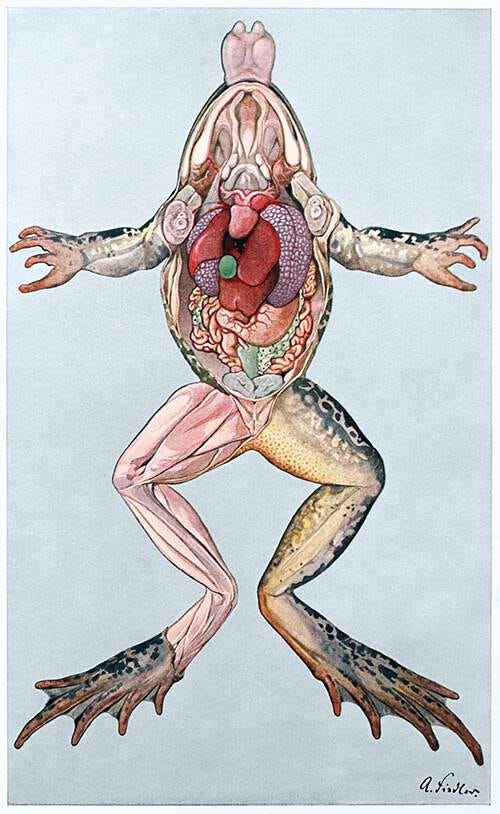
Behind those boys was a small stream or a bog, a spring in the field that may have once caused the farmer trouble. But he was dead and the field no longer was farmed and it now contained only a thick moisture in July. A vernal pool, a home for the frogs and the salamanders and whatever else needed wettening. One trillion years of evolution taught the frogs to lay their eggs here, a wetland free of fish. Their genome had not considered skinny boys, freelance science.
The smaller boy watched the wetness for a minute and then pointed. “There!” he said. He tried to whisper but it came out as a muffled holler: “Get it Jim, get it!”
Jim, the stretched boy, went flat on his belly snakelike and plucked a frog from the edge of the swamp. Its white underbelly bulged in his grasp and its legs worked like little greased pistons between his fingers. He reached out to hand it to the smaller boy but the smaller boy shook his head and pointed at the bag.
“Good one,” he said. “Thuckin good one. I like him. I like that thuckin thog.”
Chris looked around underneath his handshield. With his breath returning he could pick up the smells. The dying grasses and the baked mud in the frog pool. “What are your experiments?” He asked.
The smaller one deposited the new catch in the bag. “You know about thirecrackerths?”
“Don’t tell him Corey,” Jim pleaded.
Corey’s eyes got wide, and he thought for a minute. His face tightened and his mouth looked like it was about to burst with his gigantic teeth pressed tightly inside. “You ain’t gonna tell, are you, that thucker?”
“I’m not gonna tell,” Chris said.
“He ain’t gonna tell, Jim.”
Jim threw his hands up, shook his head. “He better not tell.”
“He ain’t gonna tell,” Corey said more sternly this time. Jim shrugged and went about kicking nothing. “We are gonna put thirecrackerths in the thogs.”
Chris thought about this. Tried to make the picture of a firecracker inside the belly of frog. An X-Ray showing the outline of the amphibian with a lit fuse in its stomach, like from the cartoons. “Can I watch?”
Corey looked at Jim. Jim moved bony shoulders up near his ears and dropped them again.
“Are you gonna do it now?”
“What, here?” Corey said, and he looked around like all Chris would have had to do is think a little harder to know his question was bad. “Damn thield’ll catch on thire. No. We’re gonna go out back of the train trackths behind Mitchell’ths, the food store.”
“Is it far?”
“Not that thar. We’ll get on them trackths back there.” Corey pointed past where the field tightened and became brush. “Back through that thick thit.”
“I don’t think I can go that far.”
“Thuit yerthself then, that thucker.”
Corey picked the bag off the ground and a cadre of captive frogs made little dimples in the fabric from the inside as they squirmed for new balance. He threw the bag up on his back and he and Jim started off across the field. Chris watched with burnt eyes as they went, their long thin bodies bouncing along between what grasses remained, carving new paths that a deer or raccoon might follow sometime later. Chris looked back to the house way across the field and felt sick, imagining his mother returning home to a Chrisless house. He turned again to the boys who weaved away from him through the field with high shoulders like movie stars and he hollered, “Wait up guys.” He hollered, “I’m coming.”
The two boys dissolved into the thick brush with bodies that warped to evade briars and dried limbs. Chris could not and so he took these natural weapons as they lay, little hooks embedding into his translucent jelly-like skin, time sharpened sticks slicing crosswise his belly like a scalpel. His eyes began to swell from the sun and from the pain but he went on, the pain of turning back he imagined would only be much worse. The boys waited for him on the tracks once the thick broke. Rusted old tracks with rotten black rail ties dislodged. The worn orange metal baking in the little oven carved from the thick. Jim sat on the metal a moment and leapt back up. He wiped at the ass of his jeans with his hand and looked at the rail as though it had become sentient and bit him.
“You ain’t never walked in the wood before?” Corey asked. “Yer all cut up.”
Chris counted his wounds, blood surfacing on little puckering slits. A briar still embedded below the knee that leaked and turned black like creosote from an old stove pipe.
“Ain’t all that thar anyway, that thucker,” Corey said.
They went on and Chris labored to keep up. His feet sloshed in the soles of his worn shoes. Fresh forming blisters filled with fluids. The boys walked on the opposite side of the tracks and intermittently found rocks they liked or disliked enough to throw as hard as they could into the thicket to their side like great submarine pitchers. The sun sat over them perfectly, like a heat lamp for an abducted corn snake. Even the summer bugs in the weeds were too hot to cry out.
“Why are you so fat anyway?” Jim asked as they walked.
“I don’t know.”
“Well what do you do all day?”
“I don’t know. Watch TV.”
“Shit, I wish I could watch TV.”
“You’re not allowed?”
“Ain’t got one.”
“Yeah we got one,” Corey said.
“Well our grandma don’t let us watch it. She don’t like us to be in the house.”
“You don’t have parents?”
“We do,” Corey said. “They’re down in Pitthburgh for a while. Dad got a new job.”
Jim said, “Dad worked on a gas rig up here but they said he was too good at it, made him quit.”
“What yer mom and dad do, that thucker?”
Chris thought about explaining what his mom did, how she worked with her hands. How she put her hair up in a shower cap. But he didn’t want to think about his mother, and more than that he did not want to be fat fucker anymore. “I don’t want to be fat fucker,” he said.
Corey whipped a rock. It made three or four noises in the woods and was gone. “Well you are.”
“It ain’t that I’m fat. I got a condition.”
“Yer retarded?”
“I’m just sick,” Chris sighed, searched for words. “But I don’t look sick. I just look… fat.”
“I never heard of that kind of sick,” Jim said.
“It’s from when I was born. It’s called stillborn.” Chris really sighed heavy now. He’d never had to explain the condition before, and the words to describe it all weren’t there. “It’s where you come out with hardly any bones and full of water when you’re born. Most people don’t live but I did and so this is just how I look. I’m not supposed to talk about it.”
Corey and Jim looked at their feet for new rocks to whip crossways. Then Corey asked for his name.
The tips of what weeds grew around the tracks baked, the dandelions went orange and shriveled. The birds had stopped flying, maybe dug deep holes with their beaks to lay in or became ducks and floated in bogs. No squirrels, no rabbits, just overheated plants and mutated trees. There was a reason for the tracks long ago, someone had big plans, big things to move and they cleared the land and laid these tracks into one end of the county and out the other. But the grasses and weeds and shrubs, little trees, they all found a way to live along the heavy metal that claimed their homes and came back in twisted, ugly ways.
“Tell me thomethin Christh,” Corey said after some time. “Can you whack off?”
“What?”
“Whack off. Do you get a boner?”
“I don’t know.”
“Then you can’t.”
Corey tightroped the one side of the track, Jim walked behind and shook hair from his eyes with neck jerks. “I can’t either, that th – I mean Christh,” he said. “I can get a boner. But I can’t, like, totally whack off. Jim can.”
Chris looked back at Jim. Jim nodded.
The thickness finally loosened, the ugly end of town had finally come into view. “We’re here,” Corey said. “Game time.” Large scale growth had been made impossible by the concrete out back of Mitchell’s, save for the timeworn cracks where things returned in green despite those big plans. Across the lot there sat a loading dock where old wood crumpled under a higher concrete slab. Blue plastic crates stacked high under the moisture blackened awning. Two formerly white trucks slept on the far end of the lot with flat tires and broken windows.
The boys, the scientists, loped down the bank from the tracks like pretty girls might in a flowering field. Chris followed with heavy steps, afraid to fall and roll forever. Corey reached into the unzipped pocket and pulled a limp frog. He held it up to inspect it, flicked its warm white belly to test its heart. Two legs spasmed.
Jim asked, “Still fresh?”
“Thtill kickin,” Corey said.
He went into the front pocket of the bag with his other hand, brought out a small dusty black cat, a little nub covered in black paper. Chris looked at the red fuse, thought again of old cartoons he’d seen. Corey asked Jim to get the lighter, and he began digging through the pockets in his pants.
Chris watched Corey peel apart the drying frog’s lips with two fingers. He pressed the firecracker into its mouth with his thumb and the frog’s arms and legs tensed between the boy’s dirty fingers. That’s when Chris figured it out, what frog fireworks meant, how science works.
The frog was placed on the concrete and blinked with a throat full of black cat. Chris watched it blink and wished he’d never come to the tracks. He wished he never walked across the field, never looked out the window, never left the couch, never saw the air purifier commercial, never thought of its benefits.
“You ready?”
A welt of tears suffocated his voice. He nodded.
Jim hit the action on the purple Bic lighter, a little blue flame erupted and held. The fuse caught. It descended the length of the fuse, the frog tried to hop when it felt its mouth burn, and in one loud snap the frog came apart in a little meatstorm of legs and arms. The smoke wisped away to show a tiny puddle of black blood.
Jim and Corey whooped. They hollered. They slapped fives and wiggled their legs. Corey put his arm as far around Chris as the girth would allow, leaning his slick little frame into the fat boy, a congratulatory hug like from a teammate in a football game.
“Thience right there,” he said. He was really grinning now, the happiest smile painted overtop his big teeth. “Bad asth, huh?”
Chris felt warm air on his gums under his own smile. He felt hot water in his eyes. He still felt wrong, guilty. He thought about his mother. But on the boys went, clapping and laughing with wide grins carved across dirty faces. The other feeling, whatever it was, was good and new. He threw his arms up. “Yes,” he said. “Awesome.”
Near the bottom of the bag the frogs seemed already dead but the science went on, the energy too palpable, the show too strong. Chris watched with wide eyes each frog turn into something else in an instant at the hand of the two skinny boys, each burst of smoke revealing a slightly deeper pool of blood, a more robust scene of charred frog parts and goo. Long dead men had made plans to farm, to build railroads. To put up shopping centers and pave the lots. Boys too made plans. Jim and Corey, they had something figured out. Chris saw that.
On the tracks headed back Jim and Corey again tightroped the metal and Chris huffed to keep up. It felt easier this time, like his hips had loosened.
“Chris you seen how high the one frog went,” Jim asked, turning back to make sure Chris was keeping up. “It went probably fifteen feet in the air.”
Chris did not remember a frog launching into the air. He tried to remember.
“Thuck that,” Corey said. “That thog went at least a hundred theet.”
“Do you think we could get one to blow up high as a skyscraper?” Jim asked.
“Higher.”
“Maybe the sun,” Chris said. “We could launch one into the sun.”
“Yep!” Corey said, and he flipped around and walked backwards on the track. His shoes twisting over one another perfectly, grapevining across the tops of the rail like a ballerina. “To the thsun!”
“Splatter its guts on a spaceship,” Jim said.
From the field Jim and Corey said goodbye, told him to find them some other time for something else, and disappeared down the road toward that sun. Chris watched them go, wondering if they’d come back up that road with it when it returned. Then for the first time in his life, Chris felt anger. Real anger. Violent, blood-pulsing hate. For no reason he knew, he needed to find his mother at home when he returned, and when he got back to his house empty as he had left it, he pounded his own face with his fists and screamed and choked on slobbery snot-filled tears until he went dry and then he felt better and was relieved his mother hadn’t been there after all.
As he lay in his bed that night there were new channels in his mind to wander, a new language to think in. He felt loose, light. Different. Over and over he replayed the boys descending off the tracks. He thought they looked like something wild, a new kind of animal made for abandoned places. He smiled and watched frogs come apart on the ceiling. A hop and a crack, a burst of colors and smoke.
Then, through the seam in his door, he saw the shadow of the cat go by and he got an idea. He rested his giant bruised head on his sore, cut hands, closed his eyes and thought more about it.